Camera-based workpiece detection instead of mechanical magazines
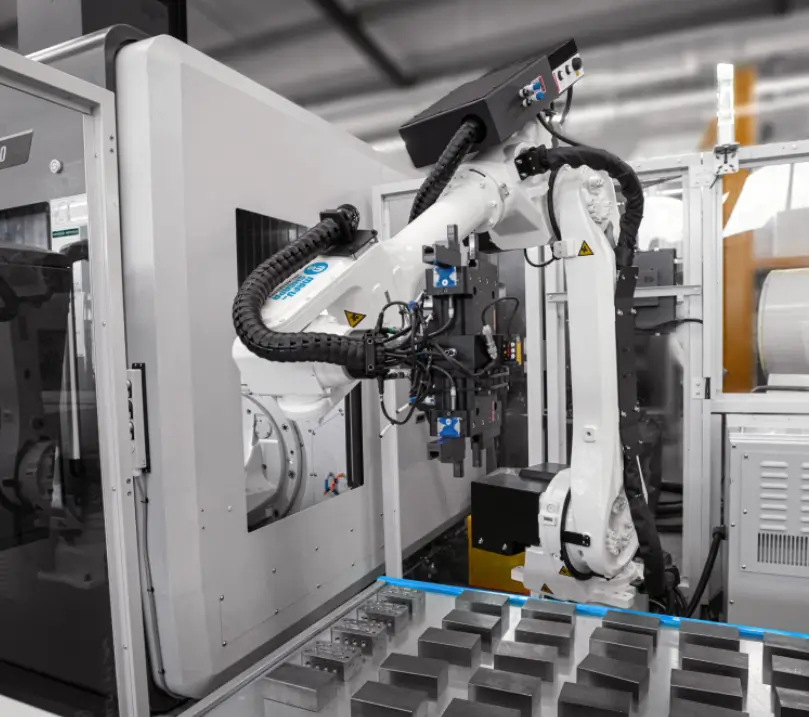
Would you like to operate your Kitamura machining centers more efficiently and make better use of the spindle time on your high-precision machines? MAFU-SHERPA camera-guided CNC automation offers robotic solutions for retrofitting existing Mycenter, Mytrunnion, and HX machines cost-effectively—regardless of their year of manufacture or control system. Whether it’s a 3-axis Mycenter, a 5-axis Mytrunnion, or a horizontal HX machining center: automation is possible for all common Kitamura series. The SherpaLoader® enhances the already high dimensional accuracy of Kitamura machines with reproducible workpiece feeding —and relieves skilled workers of routine tasks.
Non-binding adviceKitamura machining centers are known for their repeatability with very tight tolerances and Big-Plus dual-contact spindles, which ensure the tightest tolerances in tooling, mold making, and medical device manufacturing facilities. Such machines represent a significant investment—their cost-effectiveness depends directly on the number of productive spindle hours. Without automation, however, a Kitamura often stands idle for 16 hours a day because the operator is not always available. With the SherpaLoader®, the machine continues to run even at night and on weekends, consistently maximizing its precision potential.
In Kitamura-style manufacturing, dimensional accuracy, surface finish, and process monitoring are the truly demanding tasks. Manual loading and unloading ties up the same personnel in routine tasks who are actually needed for quality assurance and optimization. With the SherpaLoader®, the robot takes over workpiece handling, while the machinist focuses on tool management, measurement technology, and programming. A single operator can monitor multiple automated machines simultaneously—this alleviates the shortage of skilled workers without sacrificing the team’s collective experience.
With manual loading, the position and clamping force vary—which affects the dimensional accuracy of the first operation. On Kitamura machines with tolerances in the micrometer range, this can mean the difference between a good part and a scrap part. The SherpaLoader® positions each workpiece with identical precision and places it reproducibly in the clamping device. This ensures that machining results remain consistent throughout the entire production run—an advantage that pays off especially for small, high-value parts in the medical technology and micro-precision sectors.
The vertical Mycenter models, such as the 3XV, 4XV, and 5XV, form the core of many Kitamura applications in contract manufacturing. With the SherpaLoader®, these machines can be loaded through the front door without blocking access to the tool magazine or chip conveyor. Older models can also be retrofitted. Workpiece weights ranging from a few grams to 175 kg, depending on the project, are accommodated by the appropriate SherpaLoader® size.
The horizontal HX models with pallet changers are widely used in traditional mechanical engineering. With a two-station pallet changer, the SherpaLoader® handles workpiece loading on the setup side while the machine is performing machining on the second pallet. This allows the machine’s productive time to be fully utilized.
MedCenter5AX, which specializes in medical technology implants, is designed with a compact build, micro-precision, and tight tolerances. For the corresponding workpieces—which are typically small, lightweight, and valuable—the compact SherpaLoader® models M7 and M12 are ideal, handling parts weighing up to 4 kg and 8 kg, respectively. What matters here is not the system’s volume, but the reproducible transfer to the clamping device—exactly what camera-controlled workpiece handling delivers.
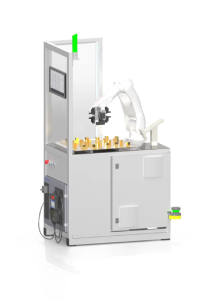
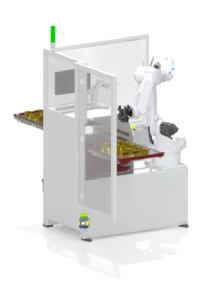
For small precision components used in medical technology, precision engineering, and electrode manufacturing,the SherpaLoader® M7 and SherpaLoader® M12 are the right choice. The M7 handles workpieces weighing up to 4 kg, while the M12 handles workpieces weighing up to 8 kg.
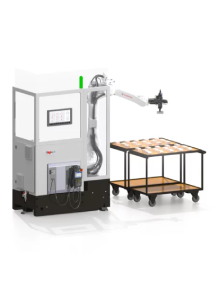
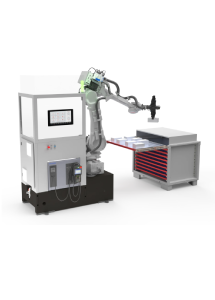
'sSherpaLoader® M25 and 's SherpaLoader® M50 cover the typical range of parts used in mechanical engineering and contract manufacturing. The M25 handles parts weighing up to 18 kg, while the M50 handles parts weighing up to 38 kg—making them suitable for steel blanks, aluminum blocks, and housing parts on Mycenter HX and Mycenter XV machines. With these two models, most standard Kitamura applications can be automated cost-effectively.
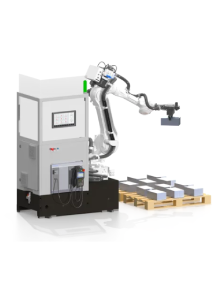
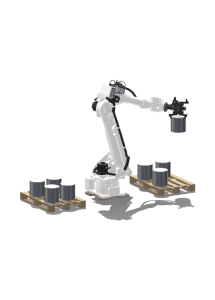
's SherpaLoader® M88 and 's SherpaLoader® M225 are available for heavy castings, steel blocks, and tooling blanks. The M88 handles parts weighing up to 73 kg, while the M225 handles parts weighing up to 175 kg, depending on the specific project. This makes it possible to automate even demanding workpieces on large HX machining centers—workpieces that could otherwise only be handled manually with the aid of tools.
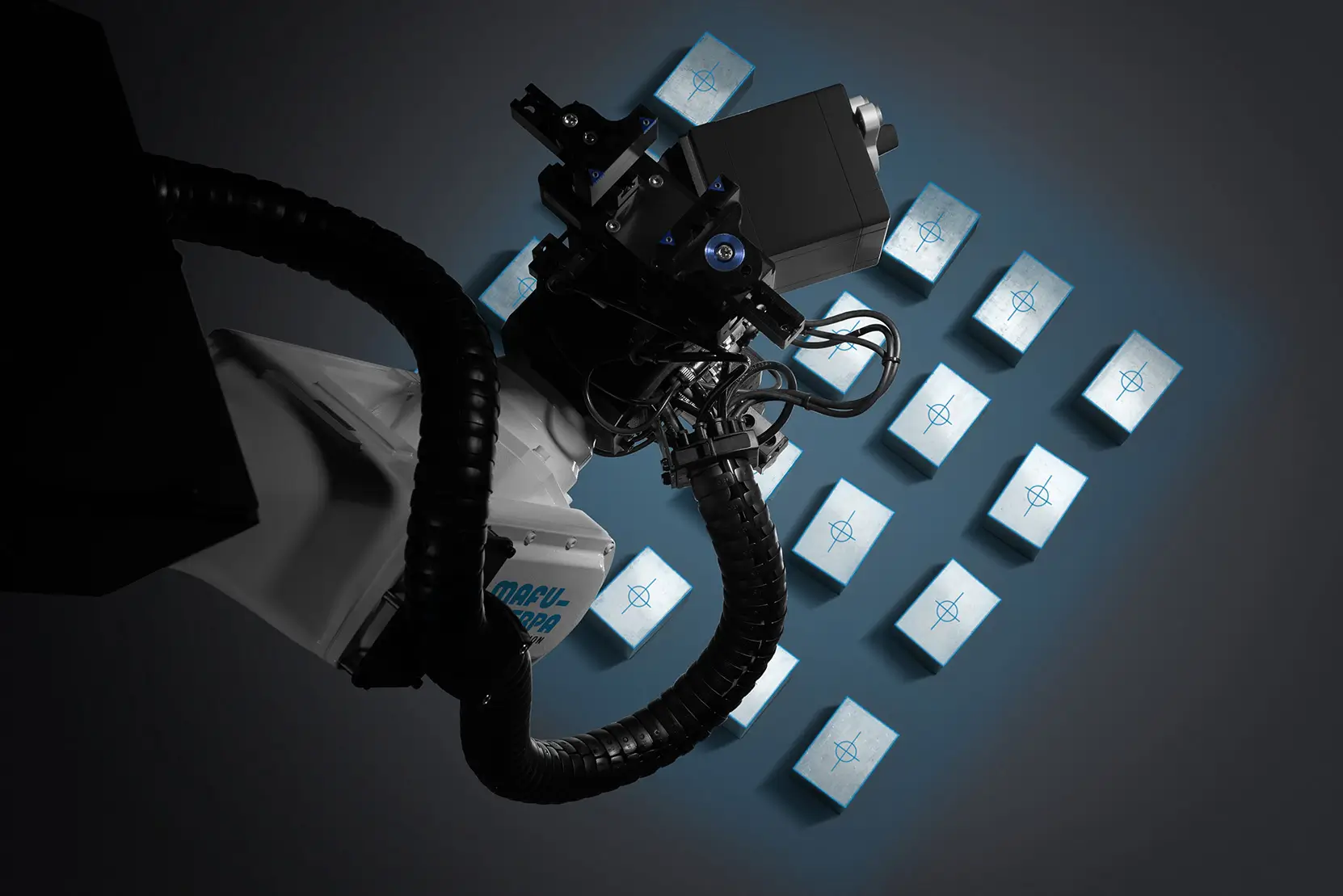
At the heart of the SherpaLoader® is SherpaVision®, a 3D camera and laser system for automatic workpiece detection. The system captures blanks exactly where they are located—without grid plates, without rotary tables, and without precisely fitting matrices. This eliminates the need for the mechanical fixtures that dominate changeover times in traditional loading solutions.
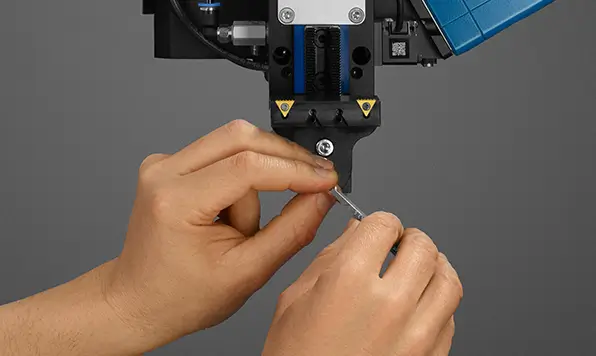
Compared to fixed grid or pallet pool systems, the SherpaLoader® is much faster at retooling. There is none need to swap dies or modify fixtures, so a workpiece change takes less than five minutes. All you need to do is adjust the gripper span to the new part size and select the appropriate job in the dialog control.
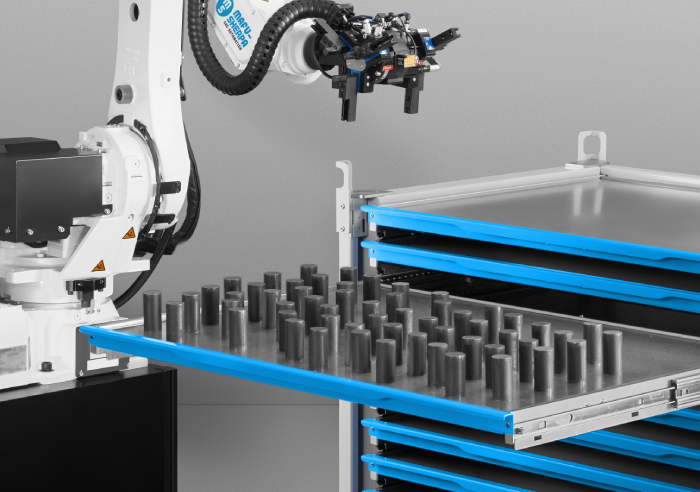
Three delivery options cover the entire range of Kitamura applications: table trolleys for prototypes and small production runs, SpaceBoxes for medium-volume production, and Euro pallets for heavy or large workpieces. A robot cell can accommodate two SpaceBoxes with a combined storage area of approximately 12 m²—enough space for over 3,000 small parts. For typical Kitamura applications in the micro-machining sector, the SpaceBox offers the right balance of capacity and faster loading. For large tooling parts, pallet storage in the standard size of 1,200 × 800 mm is used.
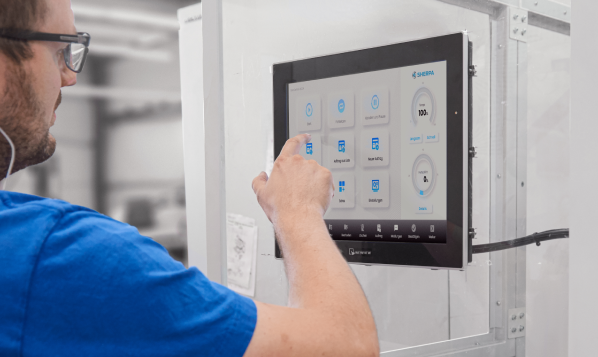
The SherpaLoader® is operated via a 17-inch touchscreen display with intuitive 17-inch dialog control. Workpiece dimensions, gripping positions, and placement locations are entered using clear input screens; the system handles the rest automatically. Even employees with no prior experience with robots can operate the system independently after a brief training session.
Current Kitamura machines are equipped with the company’s own Arumatik-Mi or Arumatik-Mi Pro. Older existing machines are often equipped with FANUC controls (e.g., FANUC 15M, 16i, or 18i). The SherpaLoader® can be integrated with all variants—via digital protocols such as EtherNet/IP or PROFIBUS DP on modern machines, or via free M functions and potential-free contacts on older models without a bus card.
The robot cell operates entirely outside the Kitamura machine and does not interfere with its mechanics or control software. As a result, the manufacturer's warranty generally remains in effect, and the ongoing warranty provided by the Kitamura service partner is not affected.
The turning module allows workpieces to be automatically turned between operations without the need for operator intervention. This enables both the front and back sides to be machined during the same shift—which is particularly relevant for Kitamura applications involving complete functional components used in the medical and precision engineering industries. The module is fully integrated into the dialog control system and enables end-to-end machining from the blank to the finished part.
The cleaning module blows chips and cooling lubricant off the finished workpieces before they are returned to the material storage area. An additional blow-off device cleans the clamping device in the Kitamura machine before new blanks are loaded.
The pre-stamping module provides narrow to wide workpieces with defined clamping surfaces, ensuring that the vise can grip them securely. The alignment module positions formed parts with consistent accuracy before they are placed in the clamping device.
The Marking module uses a carbide needle to mark each part with a serial number, date, or order number—integrated into the unloading process. The parting off module allows for the production of multiple semi-finished products from a single blank.
When properly configured, the investment in a SherpaLoader® typically pays for itself within 12 months. With high-priced Kitamura machines, the return on investment is particularly significant because every additional spindle hour on these machines yields a correspondingly high return. A customized ROI calculation is part of the consultation process and clearly illustrates the economic potential for each specific machine.
The greatest potential for efficiency gains lies outside regular working hours. A Kitamura machine loaded with blank parts on Friday evening and left to run autonomously until Monday morning can gain up to 60 additional production hours per week. This is achieved without night or weekend premium pay and without additional operators. Users report daily increases in spindle time of 10 to 14 hours.
With its Supercell series, Kitamura offers its own complete 5-axis cell featuring an integrated pallet pool for 20 to 80 pallets and an in-house handling robot. The SherpaLoader® is a manufacturer-neutral alternative—with one key difference: A SherpaLoader® cell can also be retrofitted to a single existing machine without any factory preparation and can be operated with the same cell on a Kitamura, a DMG MORI, or a Hermle. This provides flexibility for a mixed machine fleet and avoids dependence on a single supplier.
Thanks to its universal interface, the SherpaLoader® can be connected to all standard lathes and milling machines—regardless of their year of manufacture. This means that the same SherpaLoader® can be used for retrofitting an existing machine in your fleet as well as for automating a new machine.




































In principle, all standard Kitamura machining centers can be automated—of the vertical Mycenter series (3XV, 4XV, 5XV) to the horizontal HX models (HX250iG through HX630G) and the 5-axis machines Mytrunnion-4G, Mytrunnion-5G, and MedCenter5AX. Even older Mycenter models with FANUC controls can be retrofitted. For large machines such as the Bridgecenter-10G or HX1250G, workpiece automation must be evaluated on a project-by-project basis, as these machines often handle large, clamped parts.
Yes. Newer Kitamura machines can be connected via digital protocols such as EtherNet/IP or PROFIBUS DP. Older existing machines without a bus card are connected in the traditional way using M functions and potential-free contacts—without any changes to the control software.
The robot cell operates outside the machine and without interfering with its mechanics or control software. As a result, the manufacturer's warranty generally remains unaffected.
Preparatory work—installation, electrical connection, and setup of the material staging system—can often be completed while the machine is in operation. The fastest documented installation of a SherpaLoader® took three days, including training. This keeps downtime for the Kitamura machine to the absolute minimum required for final commissioning.
With a sufficiently large material storage area—for example, two SpaceBoxes totaling 12 m² or two Euro pallets—a Kitamura machine can produce autonomously across multiple shifts.
Every manufacturing operation is different. The range of workpieces, machinery, batch sizes, and available space vary from one facility to another. The first step is a systematic requirements analysis: Which Kitamura machines should be automated? Which workpieces are produced most frequently? How much space is available? Based on this information, a tailor-made automation concept is developed—including a cost-benefit analysis.
Technical data sheets provide an initial impression, while a live demonstration shows how the robot works in practice. This quickly reveals just how precise and reliable the robot is. To schedule an appointment: +49 711 2525 744-0 or info@mafu-sherpa.com.
Based on the requirements analysis, we develop a detailed proposal with a transparent ROI calculation. You’ll see what payback period to expect and what additional spindle time is realistically achievable.
From the initial consultation through configuration to commissioning, MAFU-SHERPA provides end-to-end support for the project. This includes installation, connection to the Kitamura control system, setup of the first workpiece, and operator training. After handover, a network of service partners is available to ensure faster response times. This makes the transition to automated production a routine process—not a risk.
We would be happy to show you and your team how to start and use the SherpaLoader® without any previous knowledge.
Give us a call
Write to us