Universal robot solution for all Hwacheon machine types
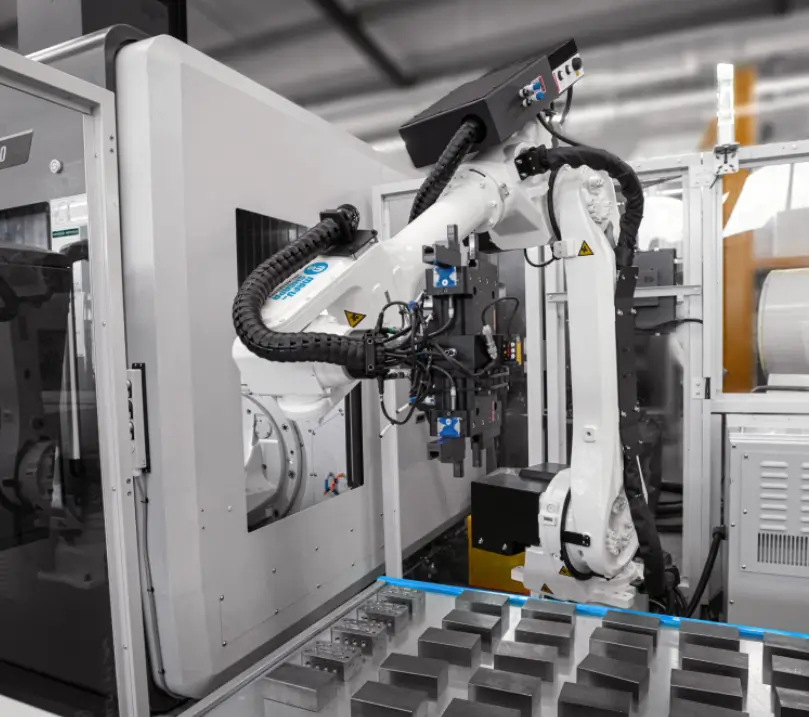
Would you like to operate your Hwacheon machines more efficiently and automate your manufacturing to make it future-proof? MAFU-SHERPA camera-guided CNC automation offers robotic solutions for retrofitting existing turning and milling centers cost-effectively—regardless of the machine’s age. Whether Hi-TECH, CUTEX, VT, VESTA, or SIRIUS: Automation is possible for all common Hwacheon series, delivering precision and productivity. The SherpaLoader® for your Hwacheon system increases spindle utilization, reduces labor costs, and makes operations less dependent on the shortage of skilled workers.
Non-binding advice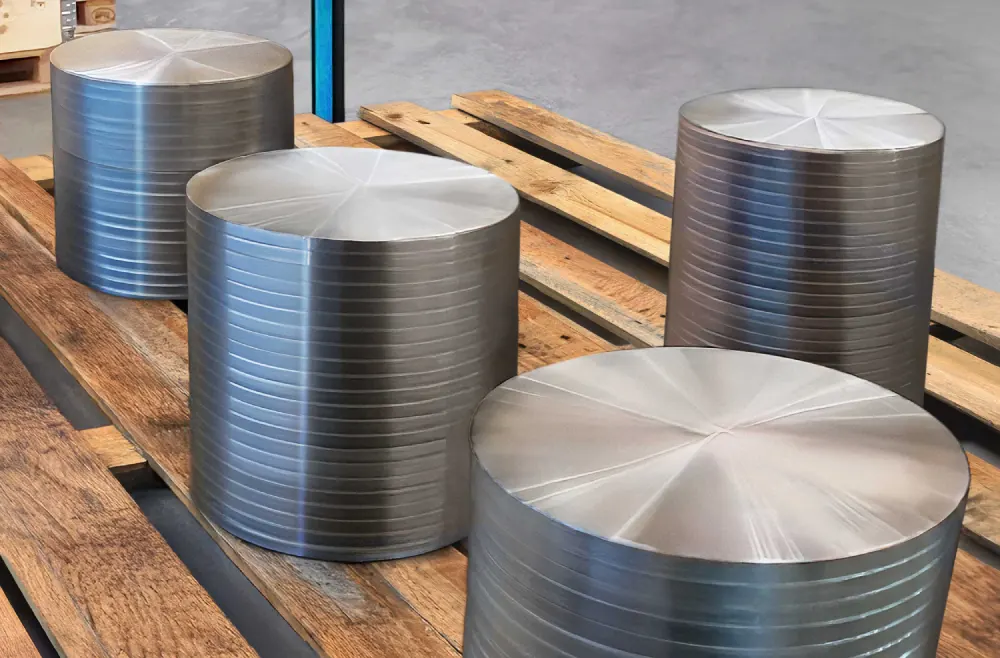
Already implemented: The automation of a Hwacheon Hi-TECH 450BL YMC for machining heavy cylinder blanks. The workpieces, weighing approximately 40 kg, are placed on Euro pallets, captured by the SherpaLoader® using a 3D Vision System, and positioned on a pre-alignment plate for length referencing. A prism station aligns each part with reproducible accuracy before it is inserted into the lathe’s three-jaw chuck. After machining, the SherpaLoader® returns the finished part to the pallet and picks up the next blank. End-to-end automation reduces downtime, increases process reliability, and ensures consistently high capacity utilization. Click here to watch the project video.
A key goal of Hwacheon Automation with MAFU-SHERPA is to significantly increase spindle runtime. With autonomous loading, the machine operates even at night and on weekends without operator intervention. This transforms a single-shift operation into a production system that achieves 16, 20, or more spindle hours per day. This noticeably increases the utilization rate and, consequently, the cost-effectiveness of the Hwacheon machine.
Manually loading and unloading a Hi-TECH, CUTEX, or VESTA ties up qualified personnel in routine tasks. With the SherpaLoader®, the robot takes over these tasks, allowing skilled workers to focus on setup, quality inspection, and process optimization. A single operator can oversee multiple automated machines simultaneously. This helps mitigate the shortage of skilled workers without losing the team’s accumulated experience.
With manual loading, the position and clamping force vary—which affects dimensional accuracy and the scrap rate. The SherpaLoader® positions each workpiece with identical precision and places it reproducibly into the clamping device. The result is consistent part quality throughout the entire production run. This advantage is particularly noticeable when dealing with tight tolerances and sensitive surfaces.
Automation isn’t just worthwhile for large-scale production runs. The SherpaLoader® is designed for batch sizes ranging from 5 to 5,000 parts and can complete workpiece changes in under five minutes. This means that automation on Hwacheon machines pays off even with frequently changing jobs and batch sizes under 100. Hwacheon users with a mixed range of parts benefit twice over—through high spindle time and flexibility in job processing.
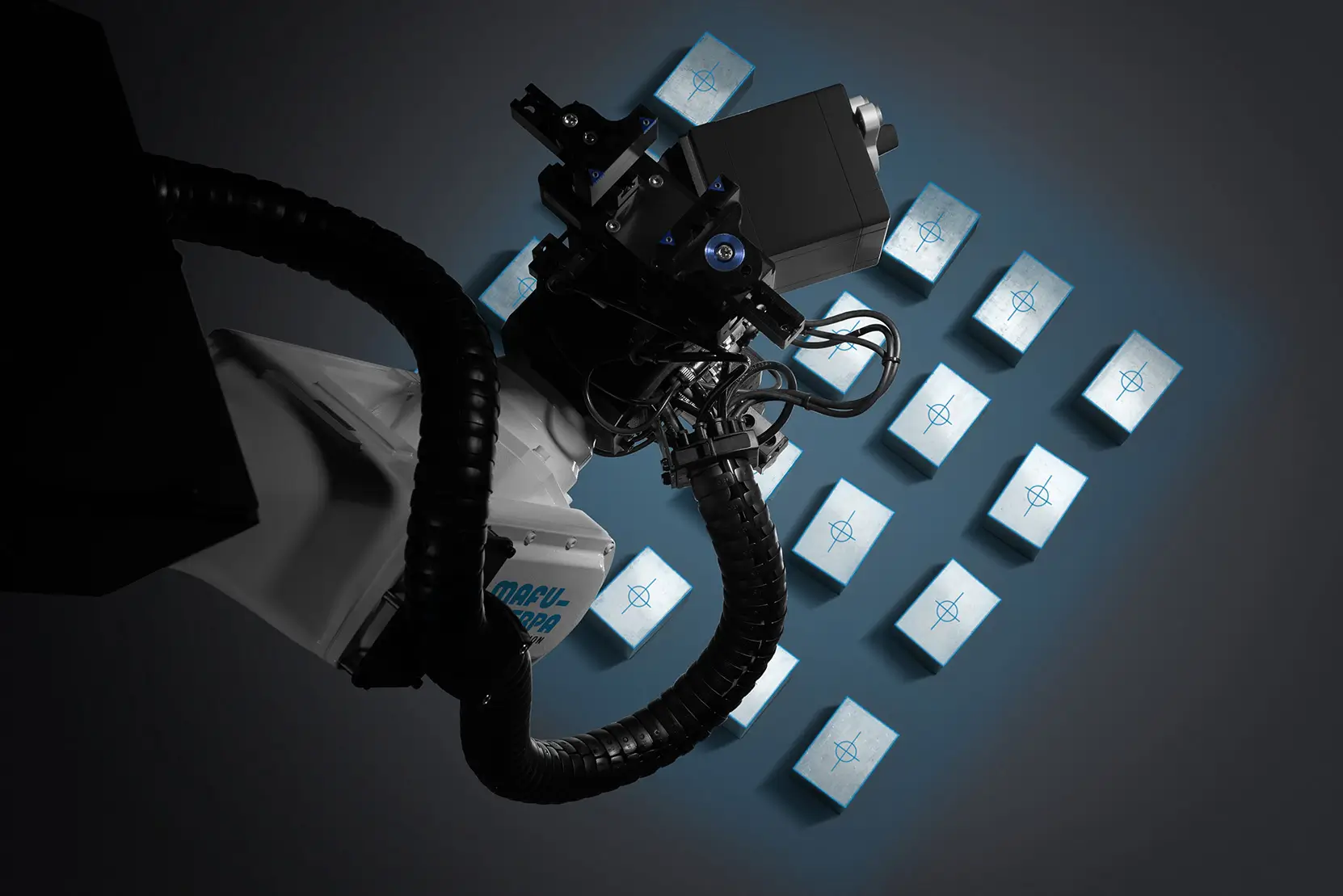
At the heart of the SherpaLoader® is SherpaVision®, a 3D camera and laser system for automatic workpiece detection. The system detects blanks exactly where they are located—without grid plates, drawer magazines, or custom-fit dies. This eliminates the need for the expensive mechanical fixtures otherwise required in conventional loading solutions for Hwacheon machines. An integrated protective flap shields the optics from chips and cooling lubricant—even in the harsh turning environment of the Hi-TECH series.
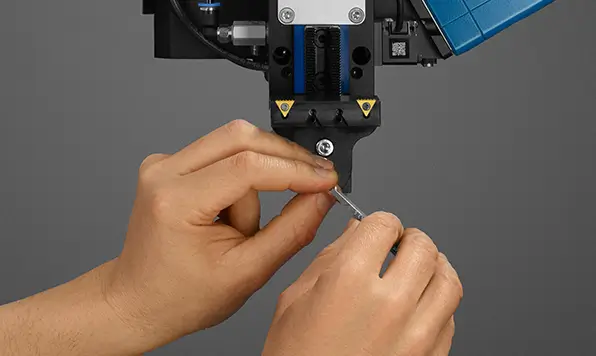
Compared to fixed grid or magazine systems, the SherpaLoader® is much faster at retooling. Since there is none need to swap matrices or modify fixtures, a workpiece change takes less than five minutes. All you need to do is adjust the gripper span to the new part size and select the appropriate job in the dialog control. These short setup times are crucial for Hwacheon users who work with varying batch sizes.
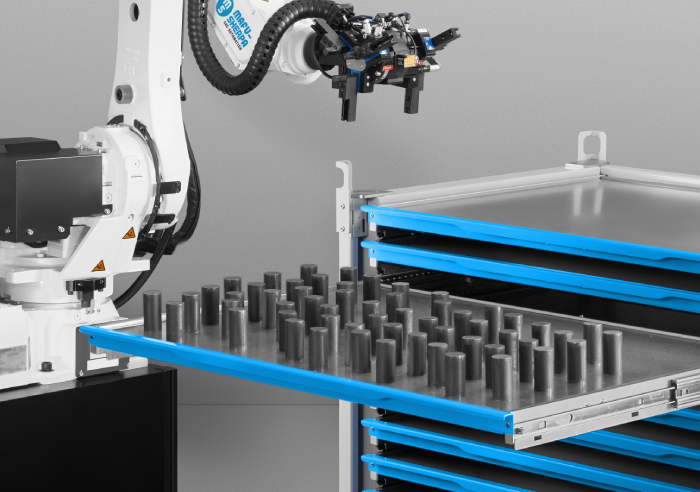
Three different configurations cover the entire range of Hwacheon applications: table trolleys for prototypes and small production runs, SpaceBoxes for medium-volume production, and Euro pallets for heavy workpieces. A robot cell can accommodate two SpaceBoxes with a combined storage area of approximately 12 m²—enough space for over 3,000 small parts. For long shafts on the Hi-TECH or heavy castings on the VESTA-1300B, pallet storage in the standard size of 1,200 × 800 mm is used. The choice of storage format is made based on the quantity, component weight, and available space.
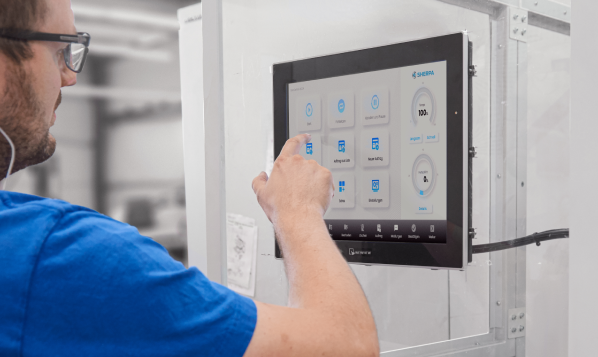
The system is operated via a 17-inch touchscreen display with intuitive 17-inch dialog control. Operators do not need to have in-depth knowledge of the Hwacheon control system or robot programming to set up new jobs. Workpiece dimensions, gripping positions, and placement locations are entered via clear input screens; the system handles the rest automatically. This enables short training periods and makes the automation accessible even to employees with no prior experience with robots.
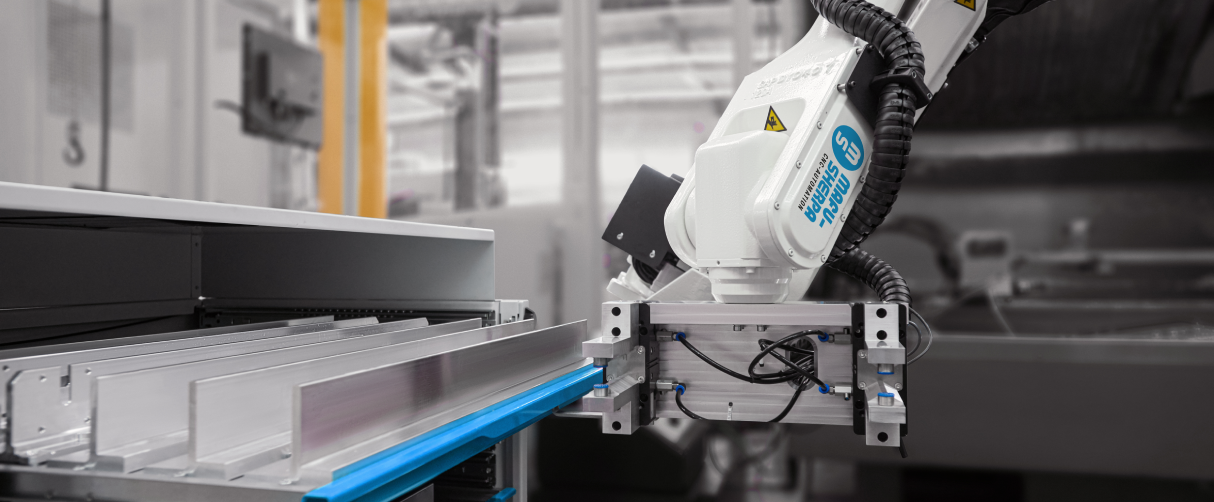
The SherpaLoader® can be integrated with all standard Hwacheon lathes. These include the Hi-TECH series (e.g., Hi-TECH 200, 230, 300, 450BL) for heavy-duty machining with flat guides, the compact CUTEX series (160, 180, 240) for general-purpose machining, and the TTC turning centers. Vertical lathes from the VT series and the Hwacheon i2 turning-milling center can also be automated. The exact model is not the decisive factor; rather, it is accessibility, clamping devices, and available interfaces.
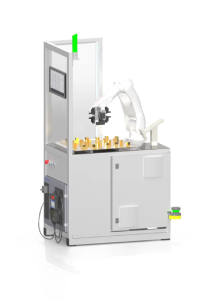
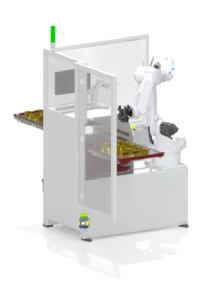
's SherpaLoader® T7 and 's SherpaLoader® T12 are ideal for lightweight chuck parts and short shafts. The T7 handles parts weighing up to 4 kg, while the T12 handles parts weighing up to 8 kg. Both are particularly well-suited for the compact CUTEX models and for applications in precision engineering or medical technology involving small cylinders with diameters up to 150 mm or shafts up to 300 mm in length.
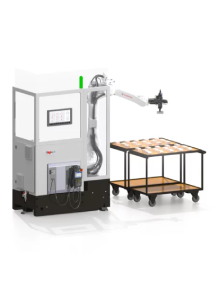
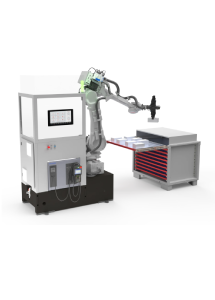
's SherpaLoader® T25 and 's SherpaLoader® T50 are designed for medium-sized turned parts such as bushings, flanges, or coupling components. The T25 handles workpieces weighing up to 18 kg, while the T50 handles workpieces weighing up to 38 kg. This means both models cover the typical range of parts processed by the Hi-TECH 200 or CUTEX 180. Cylinders up to 300 mm in diameter and shafts up to 600 mm in length can be automated in this class.
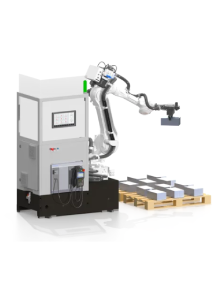
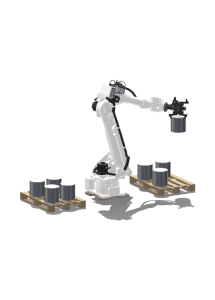
For heavy turned parts on Hi-TECH 300, Hi-TECH 450BL, or VT-series vertical lathes, the SherpaLoader® T88 and SherpaLoader® T225 are available. The T88 handles parts weighing up to 73 kg and shafts up to 1,000 mm in length, while the T225 is custom-designed for workpieces weighing up to 175 kg. This allows even heavy forged and cast blanks—which are too large for many competing systems—to be processed automatically. This size class is routinely used on the Hi-TECH 450BL YMC.
Among Hwacheon’s machining centers, the M Series covers the entire range of workpieces. Automation is available for the universal machines in the VESTA series (660 to 2000), the heavy-duty machining models in the VESTA-B series (850B, 1050B, 1300B), the large-format machines SIRIUS-850 and SIRIUS-UL+, as well as the high-speed machining centers of the HiT series and the 5-axis model D2-5AX. The HiREX-4000, designed for large components with long travel distances, can also be automated.
's SherpaLoader® M7 and 's SherpaLoader® M12 are suitable for lightweight edge materials and compact blanks. The M7 handles workpieces up to 4 kg, and the M12 up to 8 kg. Both models are suitable for the compact VESTA-660 or the D2-5AX in precision engineering, medical technology, and electrode technology. Parts ranging from 10 × 10 × 10 mm to 150 × 150 × 150 mm can be processed automatically.
The models SherpaLoader® M25 and SherpaLoader® M50 are designed for typical batch processing on the VESTA-1000+ and VESTA-1300+. The M25 handles steel blanks and aluminum blocks weighing up to 18 kg, while the M50 handles parts weighing up to 38 kg. This class thus covers the majority of Hwacheon’s jobs in mechanical engineering and contract manufacturing.
's SherpaLoader® M88 and 's SherpaLoader® M225 are ideal for heavy castings, steel blocks, and workpieces used in tool and mold making. The M88 handles parts weighing up to 73 kg, while the M225 handles up to 175 kg, depending on the project. Both models are compatible with the large VESTA models and the SIRIUS series, whose tables can support up to four metric tons. This makes it possible to economically automate even heavy workpieces that could only be handled manually with the aid of tools.
The control system landscape at Hwacheon includes FANUC 0i (standard), Siemens 828D, and—for the machining centers—the optional Heidenhain iTNC 620. The SherpaLoader® can be integrated with all three platforms without requiring any modifications to the machine software. Newer Hwacheon models are connected via Profibus, Profinet, or Ethernet/IP. For older machines, communication takes place via free M functions and potential-free contacts. This means that even older existing machines can be retrofitted.
Many existing Hwacheon machines were shipped without a factory-installed automation interface. The SherpaLoader® operates reliably even under these conditions: It connects via the machine’s existing signal paths, without the need for costly upgrades from the OEM. Machines without a rotary feed-through can be automated using the electric spindle drive, which clamps the machine vises with torque-accurate control. This means that even older CUTEX or VESTA models are suitable for robotic automation.
Hwacheon offers custom automation solutions tailored to specific projects, featuring either an integrated loader or a dedicated robot. The SherpaLoader® is a vendor-neutral alternative that can be operated with the same cell on both a CUTEX lathe and a VESTA milling machine. This provides flexibility in a mixed machine fleet and avoids dependence on a single supplier. Even different generations of machines can be served by the same robot cell.
The "Turning" module automatically rotates workpieces between operations without requiring operator intervention. This allows both the front and back sides to be machined during the same shift. The module is fully integrated into the dialog control system and enables end-to-end, complete machining—from the blank to the finished part.
The cleaning module blows chips and cooling lubricant off the finished workpieces before they are returned to the material storage area. This ensures cleanliness at the transfer point, which is particularly important for subsequent operations or measurement processes. A blow-off device on the Gripper also cleans the clamping devices in the Hwacheon machine before new blanks are loaded.
The alignment module positions formed parts with repeatable accuracy before they are placed in the clamping device—as in the Hwacheon Hi-TECH project with a prism station and pre-positioning plate. The pre-stamping module provides narrow to wide workpieces with defined clamping surfaces so that the vise can secure a firm grip. This compensates for angular cuts resulting from raw material processing and increases repeatability.
The marking module uses a carbide needle to mark each part with a serial number, date, or order number—integrated into the unloading process. The parting off module allows for the production of multiple semi-finished products from a single blank. Open interfaces also allow for the retrofitting of measuring stations or customer-specific stations. This enables the robot cell to grow along with production requirements.
When properly configured, the investment in a SherpaLoader® typically pays for itself within 12 months. The key is ensuring that the additional spindle time gained is actually utilized for jobs. A customized ROI calculation is part of the consultation process and clearly illustrates the economic potential for the respective Hwacheon machine.
The greatest potential for improvement lies outside regular working hours. A Hwacheon machine that is loaded with blanks on Friday evenings and runs autonomously until Monday morning gains up to 60 additional production hours per week. This is achieved without night or weekend premium pay, without additional operators, and without interfering with ongoing processes. Users report daily increases in spindle time of 10 to 14 hours.
Automation reduces unit costs while increasing capacity—without the need to purchase a second machining center or add a second shift. This is particularly attractive for contract manufacturers using Hwacheon machines who must respond to fluctuating order volumes. Over the machine’s service life, this effect compounds into a significant competitive advantage.
Thanks to its universal interface, the SherpaLoader® can be connected to all standard lathes and milling machines—regardless of their year of manufacture. This means that the same SherpaLoader® can be used for retrofitting an existing machine in your fleet as well as for automating a new machine.







































In principle, all standard Hwacheon machines can be automated—including lathes from the Hi-TECH, CUTEX, VT, TTC, and i2 series, as well as machining centers from the VESTA, SIRIUS, HiT, HiREX, and D2 series. The key factors are the accessibility of the work area, the clamping equipment, and the available control interfaces. Even older models not originally designed for automation can generally be retrofitted.
The robot cell operates without interfering with the machine control system and without requiring any mechanical modifications to the Hwacheon machine. As a result, the manufacturer’s warranty generally remains unaffected. The specific procedure is coordinated with you in advance and documented to ensure clarity for Hwacheon Service and internal stakeholders.
The robot cell operates outside the machine and without interfering with its mechanics or control software. As a result, the manufacturer's warranty generally remains unaffected.
Preparatory work—such as electrical connections, installation, and setup of the material staging system—can often be completed while the machine is in operation. The fastest documented installation of a SherpaLoader® took only three days, including training. This keeps downtime for the Hwacheon machine to a minimum during final commissioning.
With a sufficiently large material storage capacity—for example, two SpaceBoxes totaling 12 m² or two Euro pallets—a Hwacheon machine can produce autonomously across multiple shifts. A remote maintenance interface allows for diagnostics over the network when necessary. This enables unmanned night and weekend shifts, which significantly increase the plant’s utilization rate.
Hwacheon offers its own turnkey automation solutions tailored to specific projects, such as cell configurations with a dedicated loader. The SherpaLoader® is a manufacturer-neutral alternative that can be adapted to a heterogeneous machine fleet—today on a Hi-TECH, tomorrow on a VESTA. Camera-based workpiece detection also eliminates the need for fixed magazines and grid plates. This lowers investment costs and reduces setup time when switching between parts.
Every manufacturing operation is different. The range of workpieces, machinery, batch sizes, and available space vary from one facility to another. The first step is a systematic requirements analysis: Which Hwacheon machines should be automated? Which workpieces are produced most frequently? How much space is available? Based on this information, a tailor-made automation concept is developed—including a cost-benefit analysis.
Technical data sheets provide an initial impression, while a live demonstration shows how it works in practice. Ideally, the appointment takes place right next to the Hwacheon machine that is to be automated later. This makes it clear how the SherpaLoader® integrates into the existing environment and which setup is best suited for your facility. Schedule an appointment: +49 711 2525 744-0 or info@mafu-sherpa.com.
Based on the requirements analysis, we develop a concrete proposal with a transparent ROI calculation. You’ll see what payback period to expect and what additional spindle time is realistically achievable. The calculation takes into account machine utilization, workpiece cycle times, and margins—not just list prices.
From the initial consultation through configuration to commissioning, MAFU-SHERPA provides end-to-end support for the project. This includes installation, connection to the Hwacheon control system, setup of the first workpiece, and operator training. After handover, a network of service partners is available to ensure faster response times. This makes the transition to automated production a routine process—not a risk.
We would be happy to show you and your team how to start and use the SherpaLoader® without any previous knowledge.
Give us a call
Write to us